

Boost your conversion rates with Web Analytics
- Karthik Krishna
- Jun 11, 2020
- 6 min read

Updated: Sep 17, 2020
To increase conversion rates on your website, you would like to know its current state.
What is your overall conversion rate? Which pages are performing well (according to the numbers)?
Which pages are performing poorly? What tests are often administered supported these analyses? What are you able to study your audience and your website from all this data?
Numbers tell many stories about your website. But without the proper analysis, it’s difficult to urge the vital pieces of data . What numbers are important? What do you have to look for?
In this short guide, I’ll show you ways to enhance your conversion rates by listening to the proper metrics from your web analytics. Here are the 7 points you would like to stay in mind:
1. Study visitors’ demographic data
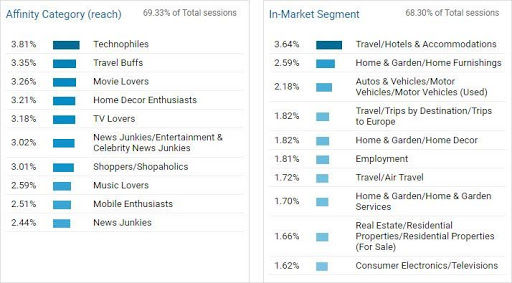
From your website demographic data, you’ll get insights into who your visitors are, what might interest them, and their behavior on your website. With a tool like Google Analytics, you’ll get a wealth of knowledge about your visitors.
For instance, common demographic data include:
Location
Age
Gender
Interests
If you run a business where your ideal buyers sleep in a selected location, then you’d want to understand how those visitors behave on your website. Are they converting? What’s their conversion rates compared to visitors from other locations?
You can create segments on Google Analytics to form these comparisons. Another example is that the age groups. Do older visitors convert better than younger visitors? What of 18 – 24 versus 25 – 34-year-olds?
You can even go further and include gender. For a page selling a present item for men, what’s the conversion rates of female versus male for that page? this is able to help tweak your message on these pages.

Furthermore, you'll find the interests of your visitors. counting on how deep you'll dive, there’s tons of data you'll uncover from your analysis. this may provide information about the conversion rates of various demographic groups and where you would like to enhance .
2. Use data to know visitors
When you undergo numbers about your website performance, one among the most objectives is to know your visitors. What does their behavior say about them? What does their demographic data mean?
Some important pieces of knowledge to trace to know your visitors include:
Pages viewed
Time on page
Major traffic sources
Best sources for conversions
Location
Gender
Language
These details and more will assist you understand your page visitors. More so, you’ll be ready to predict their needs better and make attractive offers. One tool that permits you to know your visitors is CANDDi.
Interestingly, this tool actually identifies your visitors. Thus, you'll find more unique details like their name, employer, time on site, and their activities.
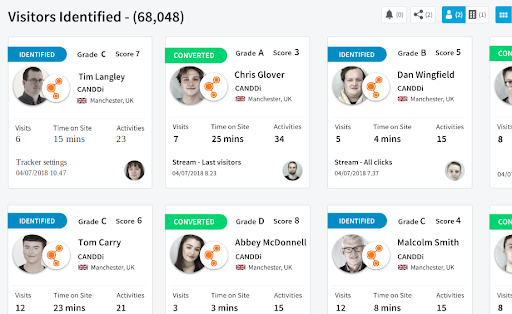
As a result, it’s easy to spot your leads and understand their needs supported their data. Furthermore, you'll use these pieces of data to create buyer personas for your business.
In a nutshell, understanding your audience will help refine your messages for your ideal audience and increase conversions.
3. Analyze landing page data
If you’re looking to extend conversion rates, you've got to pay special attention to your landing pages because they account for many of your conversions.
According to WordStream, landing pages across various industries have a median conversion rate of 2.35%. Normally, this value will vary across different industries.

No matter your page conversion rate, you would like to extend it. But first, you've got to research the info . With a tool like Instapage, you'll analyze details about your landing page performance. These include:
Time on page
Number of visits
Number of leads captured
Conversion rates
Apart from having an overall website conversion rate, you would like to research individual landing pages for your marketing campaigns. By doing this, you’ll understand how effective each campaign has been in terms of conversions. More so, you get insights to form changes to your paid ads and their landing pages.

Beyond those numbers, you'll also analyze user behavior on your landing pages. Do they read all of your page content? Where do they click?
For instance, a tool like Crazy Egg allows you to ascertain how users scroll through your page with the scroll map. Also, you've got the heatmaps which display where visitors click on your page.

Another useful feature is that the recordings, which show how users navigate your landing pages. With these pieces of knowledge , you’ll get useful insights to enhance conversions.
4. Analyze your page speed
Over the years, page speed has become an important a part of web experiences. thanks to the event in technology, visitors want your pages to load immediately. Otherwise, they’ll bounce off your page.
According to a Google study, the probability of a bounce increases by 32% once your page loads for 3 seconds. To further illustrate, another study found that Amazon could lose $1.6 billion in annual sales if its page loads 1 second slower.

Fortunately, a tool like Pingdom allows you to check your page speed. counting on your ideal audience’s location, you'll test from different locations to ascertain how briskly your visitors can access your website.
Likewise, Pingdom provides recommendations on changes you'll make to extend your website speed.
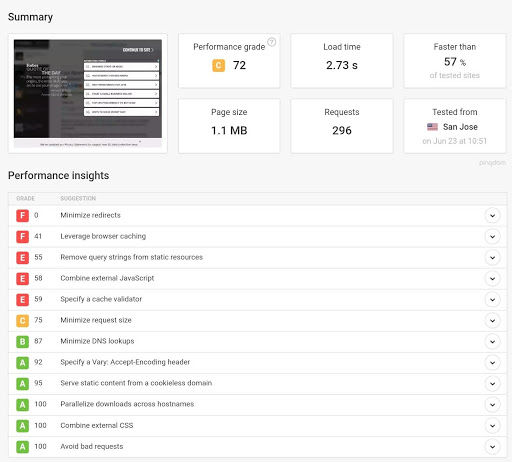
Apart from that, Google Analytics also provides speed analysis through the page timings report. Here, you’ll see the load time of varied pages. you'll also compare the load time to the exit rate or bounce rates.
With these insights, you'll take steps to extend your website speed.
5. Analyze visitors’ behavior flow
How do users navigate your website pages? With the behavior flow, you'll see how visitors move from one page to a different .
Also, a crucial datum to seem out for is that the entry and exit pages. Usually, the homepage will account for many entries. But aside from that, what other pages account for entries?
You can use the “Behavior Flow” feature in Google Analytics to ascertain how visitors navigate your website. aside from viewing entries and exits, drop-offs are an important metric.
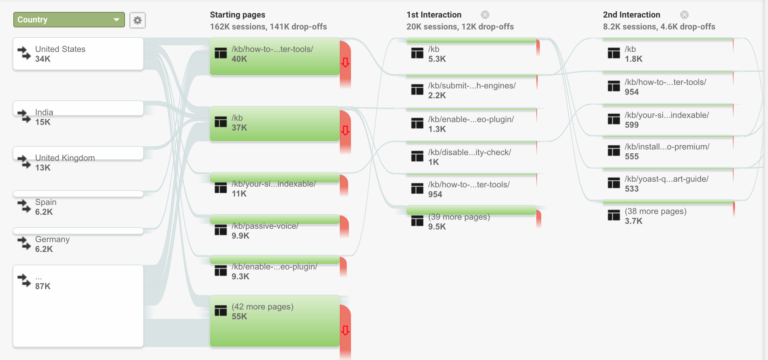
What pages have low or high drop-offs? you'll still investigate these pages and make necessary changes to extend conversions.
Mixpanel also provides the “Flow” feature that shows how your customers navigate your website. The conversion rate flow allows you to see your conversion rates and the way different criteria affect results.

You can see the highest paths to conversion which displays your best marketing campaigns.
6. Shopping behavior analysis
If you run an eCommerce business, cart abandonment is one constant nightmare. believe it; the typical cart abandonment rate from 33 studies is 69%.
Therefore, you would like to optimize your checkout process. The shopping behavior analysis in Google Analytics provides details about the amount of sessions in each page of the buying process.
With this, you’ll see where visitors drop off during the buying process. Furthermore, it becomes easier to spot pages that require urgent attention.

However, it’s difficult for these numbers alone to supply the complete picture. as an example , do visitors from a specific traffic source account for the bulk of drop-offs?
To analyze the matter further, you'll create segments of traffic to those pages, such as:
Paid search traffic
Organic traffic
Social media traffic
Tablet and desktop traffic
Direct traffic
Email traffic
Returning visitors
Location
Products
After doing this, you’ll get a clearer view of the factors liable for the drop-offs. Also, you'll investigate those pages to form necessary adjustments.

7. Run A/B tests for pages
One of the foremost important tasks for improving conversion rates is completing A/B split tests. And it’s endless task if you would like to extend conversion rates.
While analyzing data of various pages on your website, you furthermore may form hypotheses. These are changes you'll make to enhance conversion rates.
For instance, you'll change page elements such as:
Page copy
Location of CTA button
Images/videos
Background images
How does one validate or invalidate these hypotheses? A/B split testing. However, to run proper A/B tests, you would like the proper tools.
A tool like VWO can help to run differing types of A/B tests. At the top of your A/B tests, you've got access to your results. Furthermore, VWO allows you to segment your results supported user segments.

For example, how did mobile and tablet traffic convert compared to the average? These insights would help improve your conversion rates and found out future tests.
Conclusion
Today, there are numerous numbers that provide a transparent picture of your website performance. However, the main challenge is to seek out the proper numbers and interpret them effectively.
Designate has consistently increased conversion rates for its clients by engaging the most sophisticated metrics and tools to acquire, engage and convert target audiences across domains. Get in touch to know how we can boost your ROIs.
By following the steps here, you’ll gain more insights into your conversion rates and possible actions to require in future campaigns.


Comments