

Everything you need to know about Google Knowledge Graph
- Karthik Krishna
- Jul 20, 2020
- 6 min read

Updated: Sep 17, 2020
As a digital marketing expert, I inevitably find myself struggling to stay updated with the happenings round the world. I’m always keen to grab more and more knowledge from everything I encounter, but it is often difficult.
I wonder about the enormity of the human mind. From the day we are born till the instant we die, our brain collects, loads, and stores everything. This immense knowledge aids us in handling our routine.
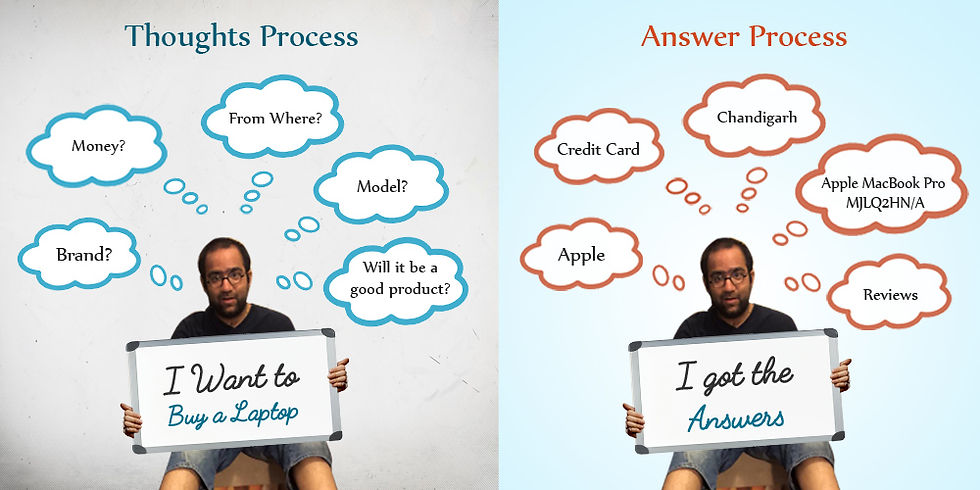
What’s even more exciting about our minds is that we will consider one thing, and thousands of other relevant thoughts will enter our heads. It’s amazing how our mind is reshaped by the knowledge it grabs every minute.
Google Knowledge Graph is the largest warehouse of data in digital history—and it’s doing it together with your help. This revolutionary system has changed the definition of the web search process.
What Is Google Knowledge Graph?
Google launched a new system in 2012 to enhance its search process, Google Knowledge Graph, getting to provide a huge amount of data in an organized way and make it accessible universally.
In a nutshell, Google knowledge graph may be a systematic way of organizing facts, people, and places to enhance the relevancy of search outcomes. With this approach, users now get quick access to surplus information and therefore the option of exploring related subjects within that search.
At the launch of the Knowledge Graph, Google Product Management Director Johanna Wright said, “We’re within the early phases of moving from being an information engine to becoming a knowledge engine, and these enhancements are one step towards that direction.”
Google Knowledge Graph does this by organizing information into “Entities” and therefore the “Relationships” between them.
How does the Knowledge Graph work?
When you search an individual on Google, say “Barack Obama,” Google will ask its data bank (the Knowledge Graph) and can display everything about Obama. Google’s Knowledge Graph is its own pool of data, where all the knowledge is collected from authoritative sites. The search results are presented based on a user’s search patterns.
This is almost like how our mind functions. Once we consider an individual in our life, say our closest friends, our mind immediately presents an image carousel before us comprised of their names, faces, families, good and bad moments we shared together, etc.
Here, the info we glance for is understood as “Entities.” Knowledge Graph revolves around these entities and their “Relationship” with each other and utilizes them to arrange relevant data for presenting within the search result. These entities real-world things, including individuals, places, organizations, works of art, movies, and so on.
Google doesn’t take a search query as a string of keywords, but rather as distinct entities.

While “Barack Obama,” “Oval Office,” “USA,” and “President” are entities here, they're associated with one another through relationships: “Work In,” “Located In,” “Lives In,” and “Designation.”
The Significance of Google’s Knowledge Graph
There are several English words with multiple meanings. Interpreting such words depends on their context. Till now, Google ignored the particular context utilized in phrases. With the launch of knowledge graph, Google has greatly improved its semantic search; it can actually understand the meaning of a given word and its relationship with the entities.
Gone are the times when the Google search process was supported by keyword match. The Knowledge Graph works a bit like our mind and is definitely ready to distinguish between the varied search queries and their meanings. With the Knowledge Graph, Google has now become more flexible. It's now capable of understanding the target of a specific search query and answering successfully by refining the search result.
5 sorts of Knowledge within the Knowledge Graph
Google divides the Knowledge Graph into five main types.

The Google Knowledge Graph is sensible, and you’ll got to get smart also to utilize it the most effective way. You’ll got to cultivate a far better understanding of how users can get things they’re trying to find within the search. Here are six tips for increasing your visibility in Google Knowledge Graph.
1. Build Your Brand Presence in Wikipedia
Knowledge Graph collects information from authoritative sources so as to make sure data reliability and accuracy. And what might be better than Wikipedia?
Having your brand on Wikipedia hooks your online presence up to a high-value online encyclopedia. Wikipedia is an influential data source, open for all, but it does follow strict guidelines on what information it accepts. To get listed your page on Wikipedia, follow these tips:
Get mentioned in third party sources like newspapers and magazines.
It’s important to possess multiple users contribute to the page.
Collect and include references to other reliable sources
Get referenced in other Wiki pages. This helps to bolster your notability.
Encourage a lively discussion page.
If you'll create a Wikipedia page for your brand successfully, you’ve got a better chance of accelerating your content visibility in GKG.
2. Register Your Brand Public Data Centres
Besides Wikipedia, Google also refers to sources like Wikidata.org to retrieve relevant information about entities. Wikidata.org acts as a secondary repository for Wikipedia and Wikisource that records statements and their sources, which successively helps in reflecting the range of data available and ensuring that it's verified.
Similarly, the CIA World Factbook may be a reference resource that gives detailed information about the demographics, geography, government, communication, economy, and military of the 267 international entities round the world.
Registering your brand on these data centers ensures Google will collect verified information about your business.
3. Organize Your Content by Schema Markup
Schema markup may be a set of predefined code that defines elements of your webpage and support search engines to return the simplest search results to users for a given query. Schema helps search algorithms understand your page content and supply additional information about the entities in an organized way. This is often what the GKG demands.
If you actually want to extend the visibility of your content within the GKG, put effort into defining important things on your website. Structured data are often used to mark up all types of things, including products, places, organizations, individual, events, and even recipes.

4. Make Your Social Media Profiles Optimized
Your social media presence is evidence that your business is a web entity. Once you stay updated on your social profiles with regular posts and reviews, it informs Google that you’re actually using your page. Moreover, Google Knowledge Graph displays information about your social media profiles when displaying information about your business within the search result.
Also, make sure to possess a Google+ page for your business. Out of all the social media channels, Google+ has the foremost impact on Google Knowledge Graph. So as to make your knowledge graph, Google will use the knowledge obtained from your Google+ profile far more extensively. Additionally, use Google+ author relation tag to form your recent posts and other valuable information visible.
5. Get More Mentions
A mention from the proper blogger can trigger a cascade of great press for your business. Getting more mentions online helps you increase your brand awareness and credibility, which ultimately gets you more traffic. The more you get mentions, the more chances your business has got to be recognized by Google Knowledge Graph. Sharing great content with consistency and regular tweeting are just a few of the ways you'll get more mentions on the business.
6. Optimize Your Google Local Business Page
According to Google, over 73% of online activities are related to the local search. So as to find out and evaluate the businesses in their area, customers often address local search. By appearing within the Google Knowledge Graph, you'll keep your business at the highest of the local search results and may get the utmost traffic.
Make sure that your Google Local business page features a 100% score, with all the knowledge filled in completely. this suggests additionally to filling in the required text fields, you ought to fill within the optional ones also . Your page should also contain product or service keywords within the description, customer reviews, and your contact details. This may help Google get complete and viable information about your business.
While it’s your job to supply the maximum amount information possible about your business, your place within the Knowledge Graph also depends on the Google’s ability to synthesize the knowledge it receives over the internet. Still, when it involves user search queries, Google Knowledge Graph can have an enormous impact on your content visibility.
Google Knowledge Graph isn't about quick wins and tricks—it’s about high-level reliable marketing efforts. The essential aim of Google Knowledge Graph is to offer useful information to the readers and permit them to form the best decision.
Designate has consistently increased conversion rates for its clients by engaging the most sophisticated metrics and tools to acquire, engage, and convert target audiences across domains. Get in touch to know how we can boost your ROIs.


Comments