

Healthcare and Medical PPC CASE STUDY
- Karthik Krishna
- Nov 25, 2020
- 11 min read

In this case study, you’ll find out how we were ready to reduce cost per lead by 60%+ during a highly competitive industry and scale the campaigns to $20k+ per month.
Want to understand how we did it?
Let’s get into it!
Background
This client is within the Drug & Rehab treatment industry. They assist individuals get over drug & alcohol addictions with in-stay treatments that last 30-90 days.
Attending one among these programs is extremely expensive, but often insurance will cover a number of the value .
To give you a thought of the prices (and customer value), on the average , a rehab center can usher in ~$1,000 per night per patient and a mean in-stay rehab program is 30 days, bringing in approximately $30,000.
In this situation, we will have a high CPA (Cost Per Acquisition) and still be profitable.
They came to us to scale back their Cost Per Lead and generate a uniform source of leads.
Initial market research
In every campaign, we always begin with initial market & competitor research. This enables us to figure through your target keywords (if you've got some) and provides an estimate of what it'll cost to urge a lead.
We also uncover many additional insights from alternative keywords to offers that competitors have, and themes that we see across the industry.
This methodology of research helps us compete right out of the gate before we ever spend a penny.
When we started, we knew this was a competitive industry and our research confirmed it.
Keywords & CPCs
In fact, the typical CPC is $65 for top intent keywords.

When searching “Rehab Center” in Ahrefs. there have been 162 domains and 375 ads at that point competing for that one keyword.
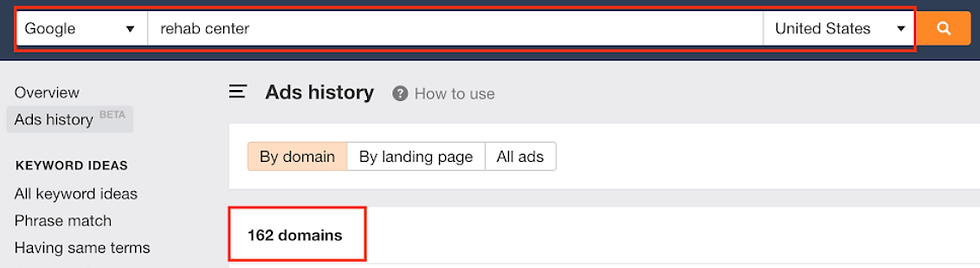
We knew our strategy was getting to need to be strong right out of the gate.
Compliance
Google features a plethora of policies counting on the niche, and oftentimes the more lucrative the niche, the more policies they need .
We help clients navigate these waters to form sure we’re ready to run compliant ads in every case. We often consult clients on sorts of ads they will and can’t run and consult on the simplest approach.
This year and beyond, compliance is extremely important.
In this case, not only can we face a high CPC and an enormous amount of competition but we also face some large restrictions from Google when it involves Addiction Services.
We were ready to help our client navigate these policies and assisted in getting their “healthcare products and services certification” from Google.
We had to stay policies top of mind and triple check everything. We’re very strict when it involves following policy here but this industry may be a special case. We didn’t want to ascertain our ads get disapproved or worse the account getting suspended.
Campaign Themes
In our campaign research, we always perform competition research, watching ads, keywords, landing pages, CTAs and more.
We’re trying to find “themes” to assist hone in on what’s important within the industry.
For example, we saw common competitor themes throughout ads and landing pages:
Types of amenities that the center has
Compelling Imagery of the particular center
Details on Insurance & what's accepted
Availability of onsite staff (24/7)
Social Proof to create trust (logos of trusted organizations)
Reinforcing that the communication is safe & confidential
With such an outsized competition during this space we knew we had to return up with some really compelling ads and landing page copy. That made our viewers feel safe, confident, and made it easy for them to require action.
Our landing page would wish to possess quite your typical CTA (Call To Action) and business information. We would to incorporate information about the on-site Doctor, a F.A.Q. section, many social proof, and interesting copy that feels very confidential.
The Audit
We also audit the Google Ads account if there's any history for insights.
We can often diagnose problems right from here, or gain valuable insight from what has worked within the past to use within the campaigns.
Here are a number of the insights we uncovered:
Conversion Tracking
Having proper tracking is significant to measuring success with a campaign – If you don’t have it found out correctly, it’s impossible to optimize in scale.
We knew we had some inquiries to answer once we saw that some “conversions” had a price of $23k a bit .

When we looked into this, we found that when someone landed on their contact page, not even taking action that it had been counted as a conversion.
When we found out conversion tracking – we’ll only be tracking confirmed leads or phone calls, so we all know needless to say the right action was taken and may optimize for that.
CPC
The next big indicator that something was strange was the typical CPC.
For these sorts of keywords and this competitive industry, the typical CPC is ~$50.

In this case, this account was getting a mean CPC $9.41 which is sort of low from our research, especially for a particular Match keyword.

These keywords with this match type are usually much higher thanks to high competition within the marketplace.
Google Ads has plenty of default settings which will rob you blind, and one among them is leaving on “Search Partners”
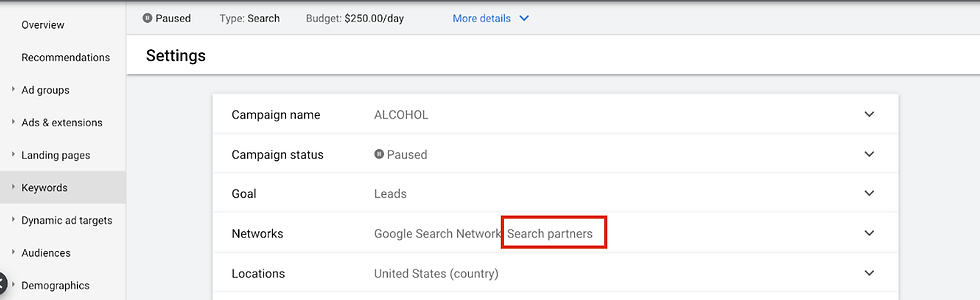
For most accounts, you’ll want to start out with this default setting turned off. By default, Google will display your ads on many other sites than simply Google.
This takes the intention of our keyword and practically flushes it down the drain. You’ll see cheaper clicks, but usually way less conversions.
The reason we spend extra money on high intent keywords is that we all know that traffic is trying to find that specific product or service.
We always keep our search campaigns solely on Google Search platforms and always disable the Search partner’s settings within the beginning of a campaign.
You will even see below how Google is making you are feeling bad for turning off Search Partners and Display Network.
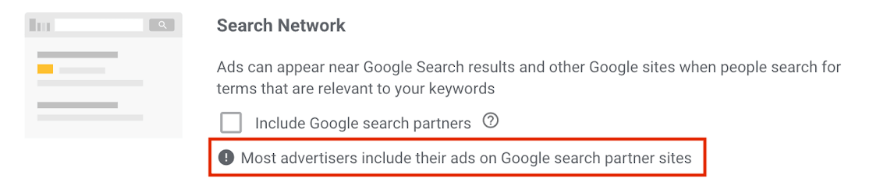
Google Ads is crammed with little checkboxes like this that we meticulously crawl through and switch off to form sure the campaign perform at the very best level.
New Campaigns & New Systems – Fixing Old Campaign Issues
With all this research complete, we went into to line up the new campaigns.
Keywords
With our initial research, we discovered a good range of keywords that we could target.
We worked with the client and narrowed down our focus to a couple of keyword groups that we thought would work best.
We incorporated an inventory of keywords that we felt were competitive also as high intent.
With only that specialize in the Search network and not running our campaigns on the Partners network we cut out many irrelevant traffic from day one.
Negative Keywords
Negative keywords assist you eliminate your ads from appearing on irrelevant keywords, or keywords that don’t match what you’re offering.
We even do keyword research for negative keywords BEFORE we launch the campaigns. We call this “pre-optimization” and helps us save plenty of cash before even launching.
We built an outsized list of negative keywords from former data inside the campaigns also as our own research.
Ads
We always split test 3 ads per ad group to ascertain which headlines do the simplest .
To get a correct split test between all 3 ads to ascertain which headlines work best. Make sure to line your ads to rotate indefinitely.
Message Match
From your keywords to ad copy to landing page you usually want to form sure you've got a “Message Match”.
This makes for a process where the traffic finds their solution and it's much easier for them to mention “Yes, this is often what i used to be looking for”.
From the initial marketing research , we found that folks were curious about the situation , about the middle , their accreditation, and therefore the experience they will expect.
These elements are sprinkled through the campaign from the ads to the callout extensions to the landing pages.
Pre-Vetting
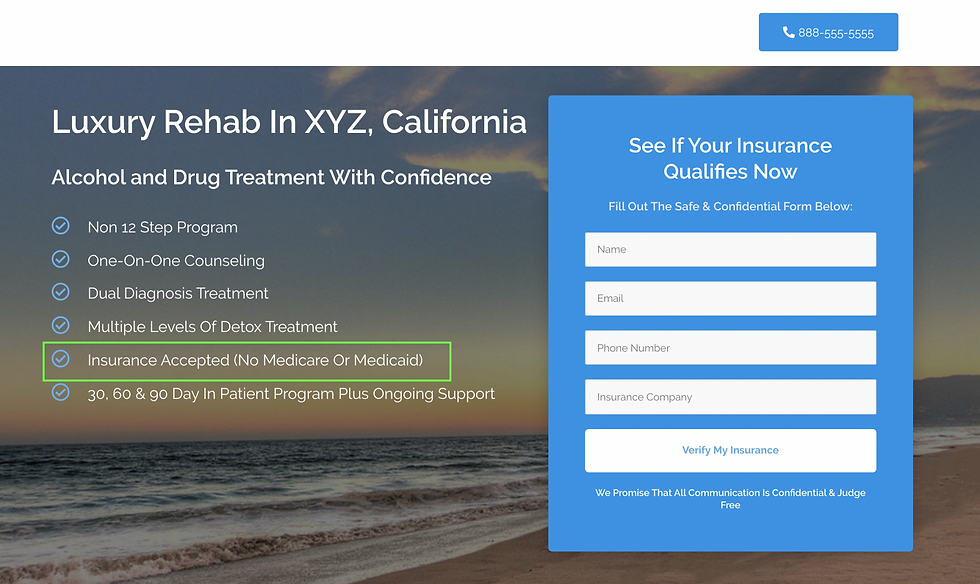
As noted within the original ad, they explain they don’t accept Medicaid or Medical insurance. this is often vital for pre-vetting but we just placed this on the landing page to pre-vet leads.
Calls vs Form Fills
The next building block to the present campaign was the “reducing friction” when it came to our landing pages.
We found through extensive competitor research that folks wanted options in contacting the business, not everyone could also be able to give their information and opt-in due to the private nature of the business.
So we built our landing pages with options to call AND to fill out the shape .

The landing page was an enormous improvement since there’s just one place on their website to click the telephone number to call.
All of our numbers on our landing page is Click To Call enabled.
CTAs
The other major piece that we implemented was seemingly small, but makes an enormous difference –
Our call-to-action was to “Verify Your Insurance”.
This was much less of a commitment and it actually qualified results in see if they might have funding to buy live-in treatment.
With this industry, we felt it needed to be as simple and confidential as possible. Throughout the ads and landing page you'll see blurbs like “Confidential & Judgement Free”, “Fill Out The Safe & Confidential Form Below”.
When writing copy traffic won't read every word or every line but most users actually skim.
So it's important to stay your copy simple, straight to the purpose , and highlight points of trust.
Conversions Tracking
All tracking for our campaigns utilizes Google Ad Conversions, Google Analytics, and Google Tag Manager.
For these campaigns, we had three different conversions setup.
New Lead Generated Via Form Fill:
This conversion is made using Google Tag Manager. When someone lands on the confirmation page, after opting-in, then a trigger is fired and therefore the data is shipped over to Google Ads.
If traffic outside of Google hits this confirmation page it'll not register inside Google Ad Conversions.
New call From Landing Page:
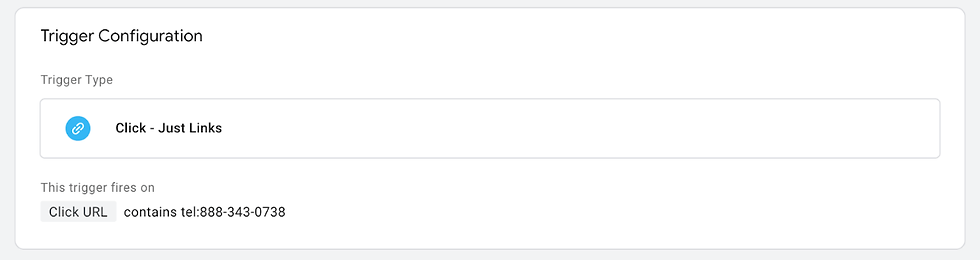
For this conversion, we built it employing a Click URL trigger through Google Tag Manager. When someone clicks our telephone number URL.
I.e. tel:222-222-2222 then it'll fire off as a replacement call from the landing page.
This call link will allow a user to form a call from mobile and desktop.

For these phone calls, you'll be ready to find the decision details which shows the time of the decision , length of the decision , if it had been missed/received, and therefore the code .
This report is extremely useful to know the standard of calls.
With the right research done, campaigns in situ , CRO driven landing page in situ and proper tracking setup it's time to travel to plug .
Initial Launch
We started with a budget of $10,000 per month for this campaign per month and therefore the campaign started in mid-October.
Within the primary fortnight , we saw their CPL’s went from thousands of dollars right down to many dollars during a matter of a couple of days.

This not only gave us good insight that our system was working but we also started seeing an outsized trend and opportunity to scale this campaign.
Optimization & Scaling
After we launch campaigns, this is often where the fun begins.
We perform daily optimizations, watching negative keywords, which campaigns are becoming traffic, what devices are working, if people during this industry like better to call or fill out forms, etc.
Taking a glance at these factors allows us to scale the campaigns while keeping the prices where we would like them!
Search Term Report
Inside all of our campaigns, we’re reviewing and optimizing them every business day.
For this campaign specifically, it allowed us to chop out the irrelevant traffic and spend money on the clicks that mattered.
For every click we've a replacement search getting added to the search term report.
We take time every business day to review the search term reports and add any irrelevant or low-intent keywords to the negative keyword list.
Here is an example.

Negative keywords
When someone searched “what is that the veteran hospital rehabilitation center” our Call Only ad for “Rehab Centers” appeared.
Although we've “Rehab Centers” as a phrase match keyword Google still counts this as an in depth variant.
Clearly Google is taking some liberties on this one and displaying our ad on a non-optimal search phrase, so we comb through these and add these keywords to the negative keyword list daily.
We see many people miss this vital step in optimization, and this is often one among the most important ways advertisers are wasting their money!
Thus, negative keywords are so important in your daily optimization.
This will allow you to urge the foremost irrelevant traffic, keep your cost per conversion low, and also get qualified traffic with the proper intent.
For this specific search, I added “veteran hospital” and hospital as negative keywords.
While scaling we saw our conversion rate increase and our CPL decrease as we perfected our negative keyword list.
Scaling Up Month 2
In the second month, the client asked us to boost the budget to $20,000 USD.
During the initial launch phase, our current search campaigns were limited by budget (meaning that there was more traffic out there if we had the allow it).
We raised our campaign budgets, plus we added on a Call Only campaign to urge more phone calls within the door.
When doubling your budget in such a brief period of your time there’s an honest chance that your conversion rate and price per lead could suffer.
Our approach to scaling this budget was to inch our daily budgets day by day and watch the consequences .
Since our average CPC was $50-$65 this didn’t “Rock” the boat an excessive amount of and that we didn’t see a negative effect on our CPL’s.

Out of all of our campaigns, we saw that decision Only was the clear winner from a metric standpoint. It had a lower CPL and a better conversion rate.
With our ad spend increasing so did the amount of clicks.
Keyword Expansion
We not only stuck to our original terms with this campaign we expanded it by bringing in additional related keywords.
Expanding on keywords is one among the foremost important steps when scaling an account. You could use many tools to seek out new keywords.
If a campaign is already running and producing leads. Then my main focus is on our data not a tool.
You can use the Auction Insights to seek out competitors who’re bidding on your keywords and also the Search Term report will offer you tons of ideas.
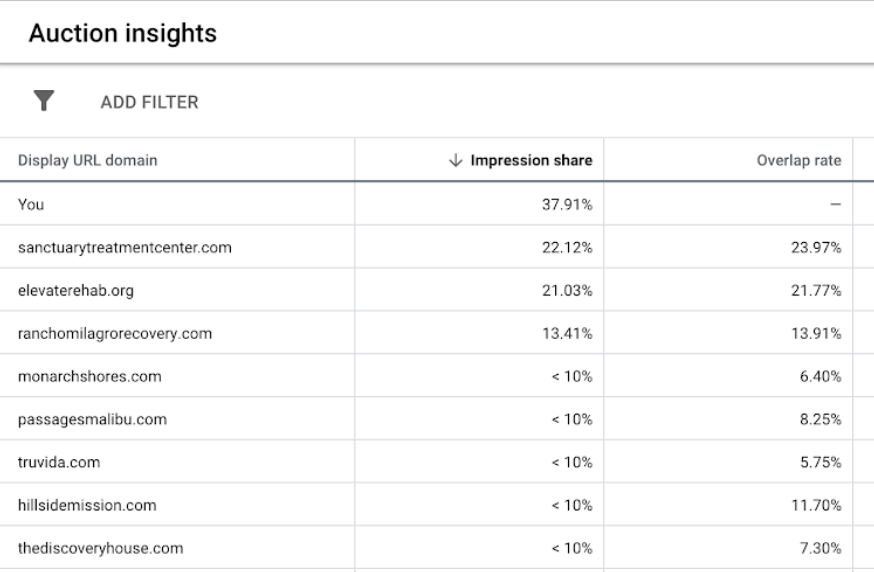
Tip: When watching Auction Insights, you now see your competition’s sites, see what keywords they’re bidding (Inside Ahrefs or similar tool) and far more.

Tip: When watching the Search term report review by the searches that didn't convert in the least . In the screenshot above I see an outsized trend of individuals typing in competitor’s name plus rehabilitation center. Now I can research them, check out new ad angles, and also add a plethora of negative keywords.
After reviewing that data you'll plug it into Google Keyword Planner, Moz Pro, SEMrush, or other tools.
CTAs For Call Only Campaigns
If you’re utilizing Call-Only campaigns. Your Call To Action must be focused on them calling your business. Confirm you’re getting creative together with your CTAs and provides them a reason to call you.
Examples
Call Headline: Call 222-222-2222 (Standard by Google. You can't change this)
Headline 1: Luxury Rehab In XZY
Headline 2: Verify Your Insurance Now
Call Headline: Call 222-222-2222 (Standard by Google. You can't change this)
Headline 1: Luxury Rehab In XZY
Headline 2: 100% Confidential Calls
During this point we saw Call Only campaigns caught some traction and grew our campaigns to great heights.
We increased the conversion rate by 2.26% and dropped our initial CPL of $404.24 right down to $329.69.
We saved $74.55 per conversion during the month of November.
We drove during a total of 55 calls that month and also 16 form fills.
When analyzing this trend from a better point of view we’re seeing that a lot of people are far more comfortable calling about this sensitive situation compared to abandoning their information.
It is vital to separate test your CTAs during your campaigns.
You will be surprised during which way people will contact you, the standard of leads from calls vs form fills, and even the CPL.
Scaling Up Month 3
During December we soaked up the budget leftover from November and used our trending data to guide us home to finish the year with a BANG!
We added more budget to our Call Only campaign and truly pulled back on the search campaigns.
This once more proved to be the proper step since we were ready to drop our CPL for the third month during a row.
Conclusion
Through our streamlined process, we were ready to dramatically improve the results for this account, reducing the first cost per lead by 67%+ and scaling to over $20k+ per month profitably.
This was all because of our intensive process that takes under consideration all aspects of lead acquisitions: From marketing research & account auditing, to keyword research & pre-optimization, to proper tracking and landing pages, to optimization and scaling.
There’s quite lot that goes into making a successful campaign!


Comments