

How to make your Facebook Ads more efficient?
- Karthik Krishna
- Sep 25, 2020
- 10 min read

With a touch of guidance, anyone can create their first Facebook ad.
Yes, we mean anyone. New marketers or experienced marketers just dipping their toes into the Facebook world can find huge success on Facebook. The key's to line up your first ad hit publish, and immediately put your learning cap on. 🧢
Every ad you create on Facebook is going to be a learning opportunity about what works best for your audience on Facebook and what you'll do BETTER next time.
So, let’s get you started on publishing your first Facebook ad so you'll become a baller Facebook marketer. (We believe you!)
Here are the 5 steps to making your first Facebook ad.
#1: Find out Your Offer and CTA
The first step in creating a Facebook ad is knowing what you’re advertising. What’s your offer and the way are you asking people to shop for in? Your offer can range from asking people to click-through to your website all the thanks to posing for them to require out their wallets and buy your stuff.
Here are a couple of samples of differing types of offers:
Lead magnet
Discount code
Buy one, get one
Free trial
Figuring out your offer depends on the goal of your Facebook ad. Would you want it to drive more traffic to your website? Wouldn't it be ideal if you grow your email list? Is that the main goal to urge more sales?
For example, if you would like to drive more traffic to your website, you’ll want to supply a lead magnet, discount code, or buy one, get one offer that motivates the person to ascertain your ad to see out the small print on your site.
If your goal is to grow your email list, you’ll want to supply a lead magnet that needs an individual to place their email address into a form so you'll send them the ebook, video, course, etc. (and then add them to your email funnel).
Or, if your goal is to urge more sales, you would like to supply a reduction code or buy-one-get-one offer that creates the person click through your ad to your website in order that they can shop your products.
There are 3 main goals behind this Facebook ad:
· Show our content to a chilly audience that wasn’t conscious of the brand (Stage 1 of the Customer Value Journey)
· Get readers to show into leads by signing up to receive the promo
· Pixel the people that clicked through to our website so we will target them with ads again
Once you’ve checked out your goal and found out what offer works well for it, you'll find out what your call-to-action is. this may be pretty easy since you’re already getting to know what action you would like someone to require to realize your goal.
For example, if we would like somebody to read our article, our CTA is “Learn More”. If we would like somebody to check in for a free trial of Lab, our CTA is “Sign Up”.
If we were asking somebody to shop for a product, our CTA would be “Buy Now”.
Alright, now that we've our offer and CTA we will start performing on the ad creative.
#2: Write Your Copy and Make Your Visuals
With your offer and CTA in hand, it’s time to tug together the copy and visuals that are getting to help get your point across. this is often your ad creative and it’s an important, crucial, crucial a part of your ad. If your copy, visuals, or both are off—you’re not getting to get the results you were trying to find.
Before you begin writing your copy and making your images or recording your video, find out where you would like this ad to be seen.
Do you want it to be a billboard in Facebook and Instagram feeds?
Is it getting to be an Instagram story?
Knowing how your ad goes to seem goes to inform you what copy you would like and the way your visual should look.
Let’s start with creating A+ copy that creates your customer avatar think, “Hey…that’s exactly what I’m trying to find.”
Here are a couple of copywriting strategies that are tried and proven:
The Power of 1
This copywriting strategy uses an honest idea, core emotion, captivating story, or inevitable response to grab someone’s attention. samples of these are:
Good idea: the way to Use Neuromarketing In Your Facebook Ads
Core Emotion: A dustcart worth of plastic is dumped within the ocean every minute.
Captivating Story: A customer testimonial talking about the difference a product has made on their life, business, etc.
Inevitable Response: You’ll Laugh once you Realize what percentage Times You’ve Made This Copywriting Mistake
Benefits Over Features
Don’t use your ad space to speak about the features of your product. These features are what causes you to get excited, but not your customers. Your customers get excited about the advantages those features will have.
For example, a productivity management tool shouldn’t be highlighting their sleek, easy to use interface—that’s a feature. They ought to be talking about what proportion time someone saves by using their tool, that’s a benefit.
Use FOMO, Urgency, and Scarcity
Copywriting uses these emotional triggers to point out someone why they ought to be buying a product, signing up for a product, or opting in.
FOMO makes people feel overlooked and like they need to mount the wagon
Urgency motivates someone to require the CTA as soon as possible
Scarcity shows a scarcity of product, opportunity, etc. and creates a faster conversion
When you use these triggers, you would like to form sure that you’re not spreading negative or fearful messages. As a marketer, you've got a responsibility to empower people—not scare them into taking the action you would like. For instance, once we market our Lab membership we never say, “If you don’t join Lab, you’re getting to be a terrible marketer.”
That’s spreading negativity and fearful messaging that somebody needs our product to be an excellent marketer. That’s not what we’re about.
Instead, we’ll say, “Join thousands of other marketers who are learning the simplest marketing strategies available immediately.” This creates a FOMO of not being one among those thousands of marketers, without making somebody feel badly about themselves.
Now, let’s specialise in your visuals, whether that’s one image or video, a carousel, or a set of images. Remember, your visual goes to possess copy included thereon. If you’re posting a product image, you'll put the worth of the merchandise on the image.
For the foremost part, you'll assume that folks are getting to see your image first, and skim your copy after. So, you’ll want to place plenty of attention on how your visual represents your offer and brand.
#3: Create a Campaign
The first a part of creating a billboard in Ads Manager is to make a campaign. During this a part of your ad creation you’re getting to be:
Choosing your objective
Deciding to run A/B tests
Turning on or off campaign budget optimization (CBO)
Let’s quickly undergo each of those.
#1: Choosing your objective
This is getting to return to the goal that we talked about in Step #1. What's the goal of your ad? Counting on that goal, you’re getting to choose your objective. By choosing the target here, you’re telling Facebook that this is often what a win seems like to you. If you would like people to click through to your website, by clicking on the “Traffic” objective you let Facebook know that this is often the goal of your ad.
Here are all of your campaign objective options:

#2: A/B Tests
Turning on A/B tests just means you’re getting to publish quite one ad with an equivalent objective. a bit like you run A/B tests in email funnels or on landing pages, you would like to ascertain which ad performs the simplest.
If you would like to run A/B tests, just turn the toggle on and choose what your test variable goes to be.

#3: Campaign Budget Optimization
Campaign budget optimization (CBO) distributes your budget across all of the ad sets in your campaign. Counting on what ad set performs best, it'll put more of your budget towards the ads therein ad set.
You can turn this on if you’re getting to have multiple ad sets with varying ad creatives. Once you switch it on, Facebook will ask you what your campaign budget then automatically moves that budget around ad sets counting on their performance (based on your campaign objective).

#4: Create a billboard Set
You’ve made it to the second to last step of making a Facebook ad! Let’s take an enormous gulp of coffee together—mmm, magical bean juice. With the caffeine coursing through our veins, we’re able to make this ad set, the ad(s), then hit PUBLISH!
Here’s what you’ll be doing once you create your ad set:
Choosing your conversion event
Choosing to show on/off dynamic creation
Choosing budget and schedule
Choosing your audience
Choosing your placements
Optimizing and delivery
Let’s undergo each option.
#1: Conversion Event
The conversion event that you simply get to settle on goes to be supported the campaign objective that you chose in step #3. For instance, if you clicked on Traffic as your campaign objective, here’s what you’re getting to see as your conversion event options.

#2: Dynamic Creative
Dynamic creative gives Facebook control over creating different variations of your ad using the copy and visuals that you simply upload for this ad set.
If you switch dynamic creative on, Facebook will show variations of the ad and visuals that you simply supplied to your audience then find out what variation is that the most successful at getting the campaign objective
If you don’t turn dynamic creative on, then Facebook will use the ad copy and visuals that you simply upload for every ad
#3: Budget and Schedule
If you’ve been nervous that Facebook goes to send you a huge bill because you messed something up once you found out your campaign, here’s the part where you don’t need to worry anymore.
This is the part where you’ll set your daily allow each ad set. For instance, you'll say that you simply want to spend $20 per day. If you've got 2 ads during this ad set, you’ll be spending $10 per day on each ad UNLESS you chose campaign budget optimization. In this case, Facebook will spend the budget on whichever ad is performing best.
You’ll also choose your schedule during this a part of Ads Manager. You'll determine your start date and your end date (see below). End dates are optional, since you'll prefer to just keep your ad running indefinitely until it stops converting.

#4: Audience
Alright, time to make a decision who’s being invited to your Facebook party! This is often a very important part of creating your Facebook ad—if it’s not being shown to the proper people then you’re not getting to get the conversions you hoped for.
You’ll choose your audience based off of:
Location
Age
Gender
Interests
Languages
Connections
#5: Placements
Now, it’s time to settle on where the ad goes to be seen. This involves both the platform and were within the platform it’s seen. For instance, you'll choose for your ad to only be shown on Instagram stories. Or, you'll have your ad be a feed post that shows abreast of Facebook and Instagram.
Facebook will ask you if you would like Automatic Placements or Manual Placements. Automatic placements will give Facebook the choice to put your ad across any of feeds, stories, apps, and sites, etc. Manual Placements gives you the choice to settle on what platform and where on the platform you would like your ad placed.
Here are the primary few options you’ll see if you select Manual Placements:

#6: Optimization and Delivery
Within your ad set, you’ll optimize for an occasion. You'll use this feature to optimize for the goal that you simply chose in Step #1 or for various events per ad set. Here are the choices you’ll see for the events you'll optimize your ad set for:
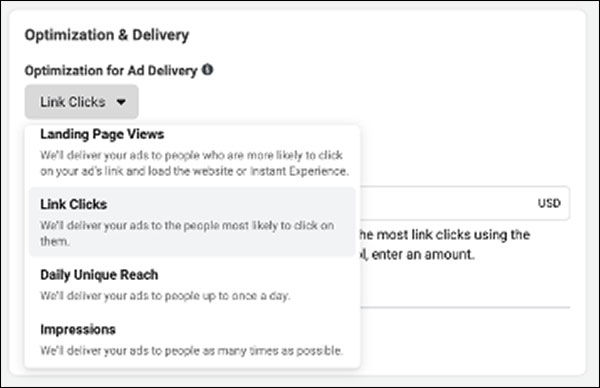
Depending on the optimization that you simply choose, you'll set cost control or bid control that puts a budget on the event. This is often optional.
And a bit like that—we have a billboard set!!
That means there’s just one other thing to do… put ads in it 🤩
#5: Create an advertisement
The final step in creating your first Facebook ad is to…actually create the ad! Now that we’ve done all the background work, it’s time to form a part of the ad that our audience goes to ascertain. Grab your copy and your visuals—it’s time to plug and play.
Here’s how you’re getting to create your ad:
Choose Identity
Choose Ad Setup
Create Ad Creative
Set Up Tracking
Publish
Again, let’s undergo these in quick detail.
#1: Identity
Identity is that the Facebook page, Instagram profile, or person who goes to publish the ad. If you've got a business Instagram account, this may be linked to your Facebook page.
#2: Ad Setup
In Ad Setup, you’ll choose from 2 options:
Single image or video
Carousel
A carousel ad has several images or videos that somebody can scroll through. Here’s an example from MudWtr.

#3: Ad Creative
This is where you’ll copy and paste your copy and upload your images or videos. You’ll have options like Primary Text, Headline (optional), Description, Website URL, and Call to Action.

While you’re putting the above information in, you’ll see your ad start to return together on the right-hand side. Take time to preview the ad altogether of its placements to form sure that it's good. If it doesn’t, you'll return into your ad set (Step #4) and switch that placement off using Manual Placement.
#4: Tracking
We wouldn’t be marketers if we weren’t planning on tracking our ads’ success! within the final step of fixing your Facebook ad, you’re getting to choose where you would like to track conversions.
All of the results from your ad are getting to be saved in your Ads Manager so you'll see the budget, results, reach, impressions, cost per result, the amount spent, frequency, and unique clicks of your campaigns (depending on what information has relevancy to your objective).
#5: PUBLISH!
Now, it’s time to hit the beautiful green button within the right-hand corner and set your ad to live! We don’t want to be totally anti-climactic here, but you'll need to await Facebook to approve your ad before it’s officially live.
But, once they are doing, your ad is live for the globe to check.
This is the inspiration for making Facebook ads. There are plenty of strategies and tips around using Facebook ads that you simply can start to implement as you get more conversant in the platform and begin to create your audience.
We just want you to recollect one thing: albeit your Facebook ad “fails” because it didn’t hit the campaign objective you were looking for… it’s not actually a failure. You continue to learn something that brought you closer to getting the traffic and conversions you’re trying to find.
Designate has consistently increased conversion rates for its clients by engaging the most sophisticated metrics and tools to acquire, engage, and convert target audiences across domains. Get in touch to know how we can boost your ROIs.


Comments