

[STUDY] Use of Cognitive Bias and Dark Patterns to boost sales.
- Karthik Krishna
- Jun 12, 2020
- 7 min read

Updated: Sep 17, 2020

The higher up during a company you're, the more favorably you view that company. This represents one, tiny example of bias—or prejudice in favor of or against something. However, it isn’t just upper management that's biased. On some level, everyone seems to be biased. You would possibly remember of your own bias, sometimes reckoning with thoughts or decision making that isn’t entirely objective or reasonable.
Or maybe you don’t accept your own bias, instead of believing you're completely objective all the time. That’s fine, but marketers (and scientists) don’t share your perspective. The marketing industry not only acknowledges that every and everybody one among us is biased, but exploits specific sorts of it to extend sales and make advertising efforts more impactful.
As public concern around privacy continues to grow, and regulation looms over the info economy, the web tools of influence marketers believe to spot and communicate with customers are under heavy scrutiny. Consent has been a critical component of the buyer data privacy conversation, with legislators, and therefore the public demanding more accountability and clarity around how personal information is gathered and used.
All this begs the question: What exactly have consumers agreed to?
We sleep in an involved world chock-full of faux news and bias. Understanding the mechanics behind advertising can help prepare us for a future where customers are more critical of how their data is getting used, and governments are more involved in how data is collected, processed, and stored. Below we explore how marketers use sorts of cognitive bias to spice up sales, also as what these practices can teach us about the longer term of selling responsibly.
What is cognitive bias and why do marketers care about it?
Cognitive bias is an umbrella term for faulty patterns of thinking that lead individuals to form irrational decisions. for instance, the common idiom “jump on the bandwagon” could be a reference to the consequence, a sort of cognitive bias where people adopt or do something just because others do it. we will observe the consequence in trends spanning fashion, music, diets, elections, and more.
Understanding how specific cognitive biases work can inform marketing strategy and approach, also as enable businesses to exert more influence over their customers’ choices—leading to raised conversion. Obviously, influencing customer thoughts and deciding is that the end goal of most marketing. But using cognitive bias is about quite creating advertising campaigns or messaging that resonates with consumers. It requires understanding how the human mind functions and strategizing around common flaws in human thinking.
What are some samples of cognitive bias in marketing?
Looking at specific samples of cognitive bias, and the way marketers can use it in practice demonstrates how commonplace these tactics are.
Choice-supportive bias or post-purchase bias
Choice-supportive bias describes the human tendency to recollect our decisions as better than they really are. This involves hyper-focusing on the positive attributes of things that we elect, and therefore the negative attributes of things we don't choose. Marketers understand that after someone makes a sale, they're biased toward their own decision.
This form of cognitive bias helps explain why sales conversion funnels are crammed with positive affirmations. Messages like “Great choice!” immediately after a transaction occurs, also as gentle reminders about the “2 items still in your shopping cart” are designed to urge consumers brooding about products they themselves selected, reinforcing bias toward their own choices.
The decoy effect or asymmetric dominance effect
Another sort of cognitive bias popular in advertising is that the decoy effect also referred to as the attraction effect or asymmetric dominance effect. Anyone who has ever questioned concession pricing at movie theaters is only too conversant in the mechanisms behind the decoy effect. This pricing tactic is meant to convince customers to vary their choice between two options by introducing a 3rd choice that's asymmetrically dominated.
To help demonstrate the decoy effect, consider the subsequent prices for a concession stand popcorn at a movie theater:

Large: $7
Medium: $6.50
Small: $3
Which would you choose? Presented with this pricing scheme, more people are likely to perceive the $7 dollar large because of the best value and buy it. However, if the medium (decoy item) is removed the general value proposition of the massive diminishes greatly:
Large: $7
Small: $3
Under this pricing scheme, more people are likely to get the $3 small. The medium choice exists solely as some extent of comparison, and therefore the pricing scheme is meant to push people toward the more profitable $7 large.
The decoy effect allows advertisers to completely alter how consumers perceive value and is prevalent in pricing for a good sort of product—including software pricing models. These examples only scratch the surface of how advertisers leverage the way we expect to urge us to spend the extra money and feel good about our consumption. For more specific sorts of cognitive bias and the way it pertains to marketing, this text outlines 67 different sorts of it.
Dark patterns are everywhere online
It isn’t just cognitive bias that advertisers use to urge people to open up their wallets: Websites and apps exploit FOMO—fear of missing out—as well as basic human desires and instincts. As consumers generate seemingly endless amounts of private data (and advertisers happily gobble it up), the tactics that cash in of how our minds operate have grown increasingly personalized and complicated.
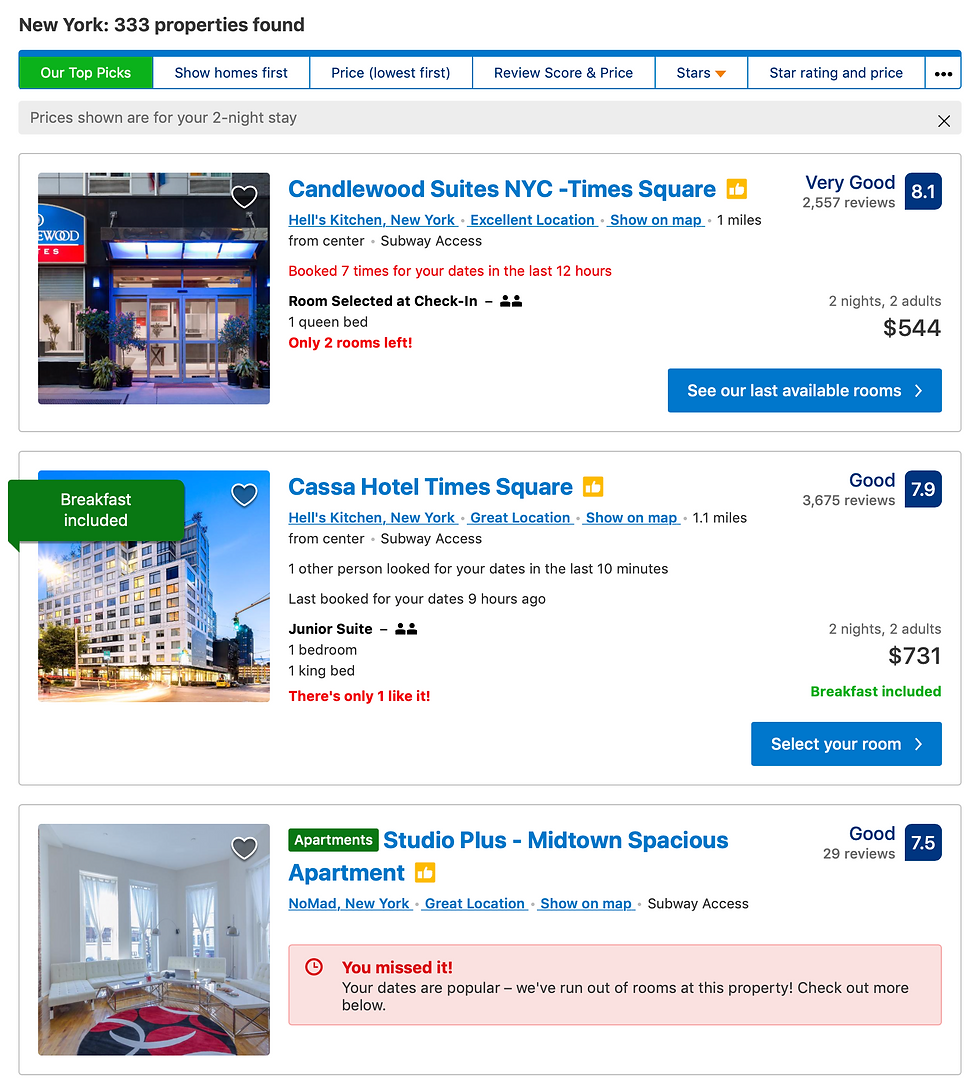
The term “dark patterns” was coined in 2010 to explain sorts of persuasion baked into user experiences that encourage the desired behavior, like purchasing a product, and discourage unwanted behaviors, like unsubscribing from something. Some samples of dark patterns might be intentionally hard to identify unsubscribe links buried during a wall of text at rock bottom of an email, or “this hotel was just booked” notifications plastered across online agency websites that make a way of urgency around booking an area.
Is using cognitive bias unethical?
While some advertisers certainly use cognitive bias to an extreme, it isn’t inherently wrong to optimize your approach to advertising by adjusting for a way the human mind functions. Ultimately, marketing is about not just understanding your audience, but resonating with them on a memorable or personal level. Accomplishing this goal is simpler if the mechanisms behind human thinking are included in marketing tactics and strategy.
While it’s difficult to completely eliminate questionable types of persuasion overnight, some lawmakers are starting to criticize the methods tech giants like Facebook use to gather user data and convince people to require specific actions.
The Deceptive Experiences to Online Users Reduction Act (or the DETOUR Act) is bipartisan legislation proposed in April by senators from Washington and Nebraska. The bill aims to ban online platforms from using deceptive techniques to trick users into delivering their personal information, as well as manipulate them into taking actions they might otherwise not take. Additionally, the proposed legislation focuses on consent or permission granted within the knowledge of possible consequences.
People must be more cognizant of what’s happening behind the scenes in online advertising, and marketers got to take more responsibility for doing the correct thing when it involves the influence they wield over consumer decisions.
Amazon uses a black-box algorithm to recommend “choice” products
A recent example that showcases the difficulties that accompany discerning deceptive marketing practices from useful ones is “Amazon’s Choice” product recommendations. Like many marketing techniques, this one came into existence as a way to appease minds and facilitate purchases.
Overchoice may be a cognitive operation where people become overwhelmed by the sheer amount of choice available, rendering them unable to form a choice. The world’s largest e-commerce website lists many many products, with the sheer volume of choices virtually limitless. the corporate recognized this was a tangle for consumers and came up with an answer called Amazon’s Choice in 2015.

The idea was to assist consumers with overchoice by giving certain products a badge that made them stand out amid a sea of seemingly endless choices. An Amazon spokesperson described the selection label as, “highlighting highly rated, well-priced products able to ship immediately for the foremost popular searches on Amazon.” However, BuzzFeed News reported that Amazon puts the label on products that are of inferiority, accompany troubling defects, or simply don’t work as advertised.
Consumers might imagine Amazon’s Choice products are curated and vetted by the corporate, but actually the label is applied automatically by a black-box algorithm that considers reviews, price, and merchandise availability. The algorithm that awards products the Amazon’s Choice label is that the company’s proprietary property, and thus unavailable to outside scrutiny.
Even our bias is biased
If you’re thinking, “all these biased people are suckers, but not me—I’m rarely (if ever) biased,” well, there’s a bias for that: Bias blind spot. this type of bias describes our habit of believing we are less biased than people, or more capable of recognizing our cognitive biases than others.
When brooding about the results and impact of manipulative marketing, it's important to avoid focusing squarely on your own personal experiences. Bias is present altogether folks, but it doesn’t impact everyone in the same ways. the rationale advertisers are ready to use it's because it works on enough people to supply a big boost to the bottom line.
Are flaws in humans deciding the simplest path forward?
Even though decoy items won’t be legislated out of pricing schemes any time soon, business owners can still enjoy asking themselves if tactics that exploit flaws in human deciding are the most effective path forward. People are increasingly wary of deceptive or aggressive marketing tactics: A recent survey found 91% of consumers in feel ads know an excessive amount of personal information about them and 52% use a billboard blocker while online.
As people wise up to the perils of unregulated marketing practices and non-existent data privacy protections, businesses that fail to know why the tides are turning and shift with them might find themselves on the incorrect side of marketing-technology history.
Designate has consistently increased conversion rates for its clients by engaging the most sophisticated metrics and tools to acquire, engage and convert target audiences across domains. Get in touch to know how we can boost your ROIs. We’d like to get to understand you.


Comments