

Tips to Boost Your SEO
- Karthik Krishna
- Sep 25, 2020
- 6 min read

SEO gets a nasty reputation as being one among the toughest parts of selling to achieve.
We’re not getting to say SEO is straightforward but we also don’t want you to think that boosting your SEO rankings is too far out of reach. When it involves your SEO strategy, you'll have a long-term, super complex strategy that’s getting to land you because of the first search result for an inquiry term.
And, you'll have a short-term SEO strategy that just helps boost your high higher within the rankings. It doesn’t need to be overly complex and most of it is often wiped out a couple of hours of labor.
We’re getting to specialize in the latter during this article and show you the tiny ways in which you'll boost your SEO rankings. These are all tasks that you simply can fit into a couple of hours of labor and may make an enormous difference within the future.
A quick tip: Start using the following pointers on your new content in order that you don’t need to return and add them in later.
Here are 5 small ways to spice up your SEO rankings.
#1: Structure Your Content For Readability
Part of an internet site page’s SEO ranking factor is page duration, a.k.a how long the visitor spent thereon page. There are a couple of ways to form sure that visitors don’t bounce off of your page (we’ll mention more of these later) but one among the highest ways is to form your content reader-friendly.
To make our content reader-friendly, we use:
· H2, H3, and H4 headers
· Bold and italicize text to interrupt up longer paragraphs of text or to spotlight a specific sentence
· Emojis to bring some color and familiarity to our content
· Images as possible so you'll see what we’re talking about rather than just reading about it
· Bullet points to assist show our point without adding unnecessary filler words
All of this helps our website visitors come to a piece of writing, sales page, or landing page and be ready to skim it over to ascertain if it’s the content they were trying to find. If the solution is yes, they’ll stay awhile and skim what we've to mention.
On top of creating our content easier to read for humans, it also helps out with the Google bots who determine SEO rankings. Once we use keywords in our headers, we’re ready to show Google that we’re talking about the keyword that we’re hoping to rank for. This shouldn’t be confused with stuffing your headers together with your keywords, which will just confirm your content feels unnatural and salesy.
You can use how this text was structured as a blueprint for your own article. You could also take a glance at our sales page and landing page to ascertain how we’ve structured those to be human and Google bot friendly.
#2: Fix Your Broken Links

This may not sound sort of a huge deal but if your content is filled with broken links that cause 404 pages, your readers and Google are getting to be disappointed in you.
On the reader side, if they need to click-through to read or watch another piece of content that you simply told them about and therefore the links are regularly broken, you’re creating a nasty user experience. For somebody new your brand and within the Engage Stage of the Customer Value Journey, they’re getting to make a subconscious judgment that you simply might not be totally trustable.
At this stage, you would like your results to see you as someone that always follows through with their promises. 404 pages don't tell them that.
On the Google bot side, 404 pages are getting to show them your website visitors are coming to your page and leaving immediately. That’s because whenever a visitor sees a 404 page, they’re getting to hop off that page in seconds. Since there’s no content for them there, they need no reason to stay around.
This tells Google that your website isn’t providing the worth that a visitor had hoped for, and your credibility goes to travel down. When your credibility decreases, Google favors the opposite websites with similar content that doesn’t have high bounce rates.
There are 2 sorts of broken backlinks that you simply want to fix:
Internal backlinks from one page of your website to a different
Outbound backlinks from another website to your website
#3: Don’t Skip Out On Your Meta Description
While your meta description doesn’t need to do together with your SEO ranking in terms of the content that you simply put into it—it does affect whether people click on your content or not. You'll be able to boost your SEO ranking by having a killer meta description that creates people desire it’s IMPOSSIBLE to not click on your article.
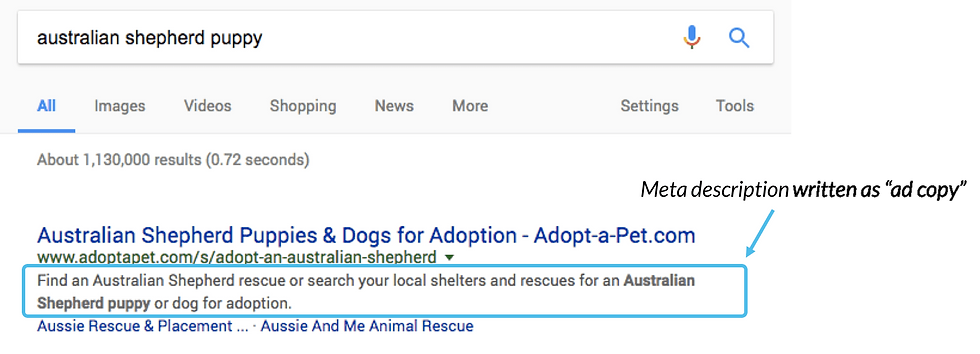
A meta description is often for a landing or sales page of your website or it might be for a blog post. If you’re writing a meta description for a blog post, you would like to form sure that you’re showing what the reader goes to seek out out and planting a seed of curiosity so they’re motivated to find out.
#4: Update Older Content and Republish
Efficiency is vital for each a part of your marketing strategy (from content to SEO, to social). If you've got blog posts on your website already, you don’t necessarily get to be writing fresh content on a daily basis. What that post from a year ago that did quite well but its pageviews are going lower and lower each month?
Instead of leaving it in blog post purgatory bring it back to the front lines.

You can run through old blog posts to ascertain what you'll increase them to update the knowledge or to only make them better then republish them under a replacement date. To be clear, you don’t even get to create a replacement post, you'll just change the publish date of the post to be the date that you simply publish it again.
#5: Prioritize Your Content
What happens once you read a stimulating headline, click the link to read more of the article, and are immediately bombarded with a sink ad, a billboard on the side of the content, ads opened up every few paragraphs of the article, and a billboard arising from rock bottom of the page?
We rarely think, “Wow, this is often an excellent experience!” We barely even bat an eye fixed before we click back on our browser.
That website owner can say goodbye to page duration and hello to an increased bounce rate.
While it’s extremely tempting to place pop-ups, Google ads, or ads for your own products everywhere your website, it’s a dangerous SEO game to play. You’ll find yourself losing quite your gaining which loss surpasses your SEO ranking.
The high bounce rate will have a negative effect on your ranking, but it'll even have a negative effect on how website visitors view your brand. If they know that you’re getting to bombard them with ads when they’re just trying to read a piece of writing, how are they getting to feel comfortable supplying you with their credit card?
When you’re focused on your SEO strategy, you’re usually focused on the primary 3-4 stages of the Customer Value Journey. You’re focused on getting people to subscribe or maybe convert on your tripwire. But if somebody seems like your website page may be a digital billboard, they’re not getting to think the emails you send them are getting to be much different.
They’ll worry that you’re just trying to urge the sale, not actually help them solve their problem.
Guess what that does to your click-through rate. Yep, you guessed it. 📉
Always prioritize your content first so you’re building a trustworthy relationship together with your new website visitor. This increases your page duration (and SEO ranking) and your chances of turning that visitor into a lead.
As promised, these are all fast ways in which you'll improve your SEO ranking—without having to spend hours and hours (or dollars and dollars) on getting the results you would like.
And remember, these aren’t just tips that you simply can use on your current website. You could also use them when creating all of your future content in order that you’re being the foremost efficient SEO marketer possible.
And who doesn’t love the sound of that?
Designate has consistently increased conversion rates for its clients by engaging the most sophisticated metrics and tools to acquire, engage, and convert target audiences across domains. Get in touch to know how we can boost your ROIs.


Comments