

What is CRM?
- Karthik Krishna
- Sep 12, 2020
- 5 min read

Updated: Sep 17, 2020
Customer Relationship Management (CRM) usually refers to the database of records for prospects and/or customers. They are available in many sorts and specialized versions, so we use the term generically.
What is marketing automation?
Marketing Automation (MA) refers to the suite of tools and capabilities that leave automated, triggered events including email, text messaging, variable content, lead scoring, conditional logic rules, communication workflows, etc. These two sets of capabilities, (CRM + MA) can reside in one all-encompassing platform or two (or more) systems that exchange data bi-directionally. There is no one-size-fits-all solution. That’s a part of the challenge in selecting the simplest systems(s) for your specific needs.
The combination of a CRM system or database of record and a process to automate marketing messages enables you to speak on the basis of individuals’ attributes, reactions, engagement, and channel preferences. That an extended way of claiming, “Speak with individuals as individuals in ways in which are most relevant to each of them.”
There is a key principle that everybody within the decision-making process must remember. It’s analogous to the four pillars holding up the roof to the entire CRM + Marketing Automation process. It's like this:
Management has got to be clear and committed to all four pillars to realize success.
The Four Pillars of Nurture Program Success
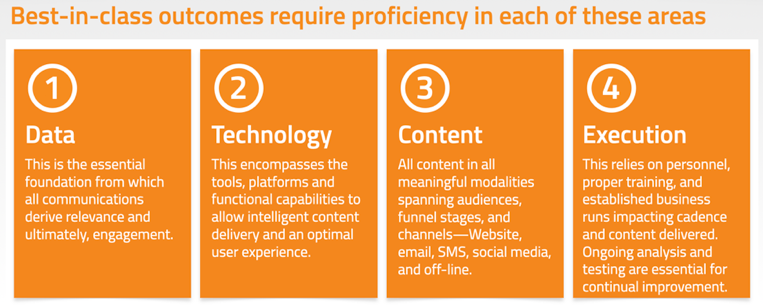
Take an in-depth look at that. If you remove, or maybe short-change any of these pillars, the entire marketing automation is doomed to a sub-optimal outcome. This often to becomes the lifeblood of most organizations’ sales funnel and revenue. This is often not the place to chop corners. Management has got to be clear and committed to all four pillars to realize success.
How to Consolidate and Improve the Whole CRM and Marketing Automation Process
For those that have some kind of system and tools cobbled together, where can one begin to consolidate improve the entire process?
First, let’s agree we are talking about improving the entire process for everyone: the prospects/recipients, the marketers, the tacticians, and therefore the management. When done correctly, everyone wins.
The most important thing to recollect when undertaking a CRM + MA upgrade is perhaps what not to do. Don't leave and begin looking at demos of various systems. All of them have shiny, whiz-bang demos and colorful charts and seemingly simply drag and drop GUIs, but that’s the incorrect way to set about an evaluation.
The Best Way to Demo Marketing Automation Solutions
The correct way to demo marketing automation platforms — the way that's much more likely to yield a successful outcome — is to try to do this:
Document your current capabilities, breakpoints, shortcomings, and limitations (this is your current state)
Document the features and functionality you would like to possess within the future (future-state). It’s okay to stretch a bit here; you'll not get everything you'll dream of, but still anticipate a couple of years.
This list of future-state capabilities should be comprehensive, but not necessarily exhaustive. More thereon during a moment.
How to Evaluate Marketing Automation Solutions
Step 1: Increase your list of Features and Functional Requirements interview questions, including:
The number of reviews and cumulative rating score (G2, Trust Radius, Capterra)
Company size, number of employees, and how many are in customer service
Capitalization structure (VC funder, latest round, privately help, publicly-traded, etc.)
Implementation time
On-boarding process: does it include data migration?
The underlying database product (Microsoft Dynamics, Oracle, Salesforce, or proprietary?)
Are there specialized products for your particular industry? (e.g., education, homebuilders, non-profits and fundraising, etc.)
And don’t worry about pricing at this stage. Don’t even bring it up.
Step 2: Next, filter through the list of candidate CRM + MA packages and develop a short-list of no more than 10.
Step 3: With these 10 candidates, initiate the sales process with each, by:
· Scheduling a call with their sales rep to verify if it's a candidate for your particular business
· Send over your list of functional requirements asking them to see the boxes and fill in any note or explanations
· Schedule your first of two demos, 90 minutes (it’s impossible to try to do an adequate job in less time, and you’ll need a second demo once you get right down to your final two or three).
Step 4: Evaluate the Solutions Internally for a Minimum of 3-4 Weeks
Now, this is often getting to take a while. In our experience, it’ll take two full weeks minimum to travel through the dialog, checklists, scheduling the demos, follow-up questions, etc. And you almost certainly can’t get 6-10 done within a two-week time-frame if you and your team have already got day-jobs. So candidly, plan on a minimum of 3-4 weeks.
I’ve quite glossed over a number of the method details about the way to compile all the gathered information into a side-by-side comparison chart, but that’s detail stuff. Once someone gets into that stage of the study, we’ve got some good processes that help streamline things. I’m happy to share those; it just doesn’t bring good interview material.
How to Choose Your Marketing Automation Solution
Once you get the list right down to 1 or 2 candidates, then what?
If it’s right down to an inventory of 1, your job is basically simple. Anything above one, and you’ll need to dig a bit deeper and tease out the differentiators. There are probably no non-starters by this stage, or they wouldn’t be within the final list. This is often where talking with reference customers and price negotiations are available. And pricing models vary greatly. you ought to be prepared for multiple licenses, user fees including admins, marketers, clerks, or whatever they each name their seat and access level licenses, and a few might even be fixed rate.
We always invite a fee structure covering each of the primary three years. Year one is usually the foremost expensive because migration and implementation services are usually all rolled up therein the first year. So, three years gives a far better check out the annual cost of ownership. And it's a negotiation point. That the simplest reason to possess a minimum of two in your final list of candidates.
In Part Two of this series:
We delve deeper into the importance of knowledge, the four categories of knowledge, and the way this may cause you to rethink your CTAs and webforms!
In Part Three of this series:
The implementation journey is close to beginning. But you're not ready. There's a ton of things that can and should be done before anyone starts loading software onto servers! (or, within the cloud).
Designate has consistently increased conversion rates for its clients by engaging the most sophisticated metrics and tools to acquire, engage, and convert target audiences across domains. Get in touch to know how we can boost your ROIs.
We’d like to get to understand you.


Comments